Undergraduate researcher · Shanghai Jiao Tong University
I am an undergraduate researcher at Shanghai Jiao Tong University, working in IPADS. My research spans embodied AI, robot learning, graph learning, and route planning, with a current focus on reliable vision-language-action policies, agentic manipulation, and benchmarks that make progress measurable.
We released ManiLadder, a difficulty-calibrated manipulation benchmark with 112 tasks across 4 difficulty levels and 8 task categories, with demonstrations and trained checkpoints. It has not yet been solved by Astra. Website · arXiv · X
ManiLadder received the Outstanding Workshop Paper Award at the IROS 2026 Bimanual Robot Learning Workshop, “Scaling vs. Structure?”
Grant
Selected as the student PI of an RMB 100,000 NSFC undergraduate project on OpenHarmony embodied-agent systems.
Paper
RoboHarness was accepted to IROS 2026; I am the first-listed co-first author.
Paper
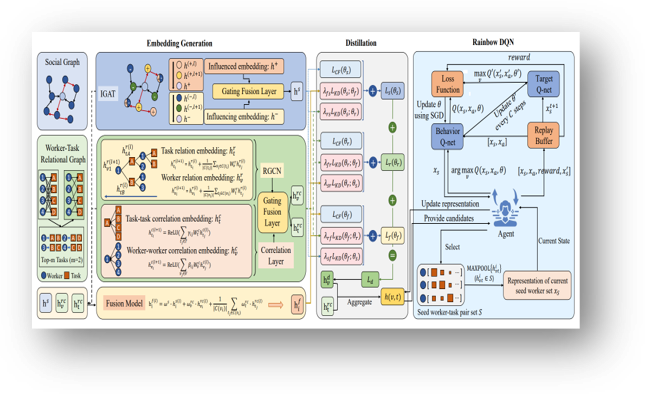
GKD-Recruiter was accepted as an ICML 2026 regular paper; I am a student co-first author.
Paper
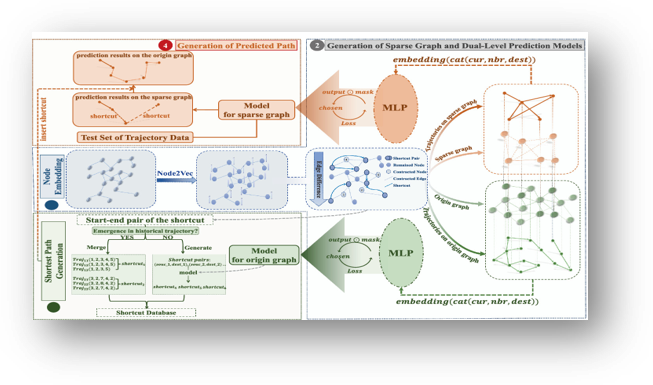
DRNCS appeared in ECML PKDD 2025; I am the sole first author.
Selected work
Research, systems, and benchmarks
CVPR 2027 · Under review · First author
CaTS: Code as Tactile Supervisor
CaTS grounds robot agents in contact-rich manipulation. From a single human RGB-D demonstration and physics-grounded tactile-pattern priors, an agent synthesizes stage-wise tactile supervisors and compiles them into a locally executable program that needs no foundation-model calls at run time. It outperforms all evaluated baselines across 6 real-robot and 20 simulated tasks.
RoboHarness: A memory-augmented policy harness for VLA robustness
RoboHarness adapts frozen vision-language-action policies through dual-memory retrieval and attribution-driven interventions. Across three VLA backbones, it improves average success by 56.6 percentage points, including 89.1 points on long-horizon tasks.
arXiv 2026 · IROS 2026 Workshop Outstanding Paper Award · Core developer
ManiLadder: Benchmarking robot manipulation through a categorized, multi-difficulty-level task ladder
What makes a manipulation task easy or hard? ManiLadder answers this systematically: 112 simulated tasks in 4 difficulty levels and 8 task categories, where each level is set by the success rate of an imitation-learning policy under the same training budget. Every level spans grippers and dexterous hands, rigid and deformable objects, and single- and dual-arm settings. Each task ships with demonstrations and trained flow-matching, π0.5 and Astra checkpoints, and the benchmark is not yet solved by Astra.
GKD-Recruiter: Graph knowledge distillation for spatial crowdsourcing
GKD-Recruiter combines directional social influence with worker–task affinity and uses graph knowledge distillation plus Rainbow DQN to recruit workers for the right physical tasks under limited demand.
DRNCS: Dual-level route generation through contraction and shortcuts
DRNCS builds a sparse road graph with shortcut-edge differential contraction, then generates routes on the contracted structure. It reports 0.3–0.8 ms per trip and more than 40% faster queries across five real-world datasets.
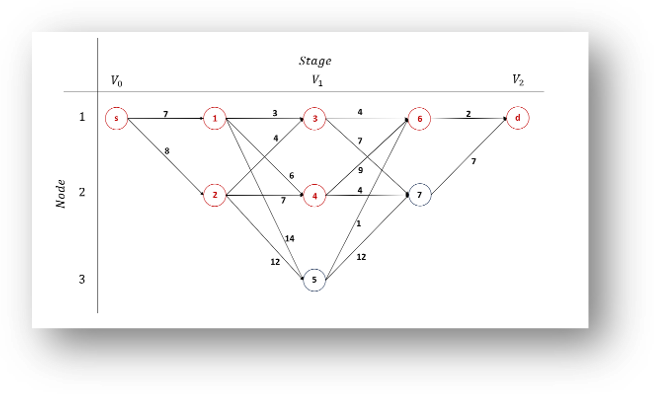
Two exact, linear-space algorithms solve ordered waypoint tours on road networks. Stage Dijkstra reaches the best-known time bound, while Global Dijkstra is faster in practice on large graphs.